
We don't need more nonprofits–we need better-equipped ones.
I can’t tell you how many times a week people post on nonprofit forums, “How do I start a nonprofit?”, or some variation thereof. I’ve seen dozens of these posts in the past two weeks alone.
The good news is that people want to make a positive difference and fight against injustices. It’s heartening to see as we need more giving, helpful souls in the world. The problem is, we don’t need more nonprofits, we need better-equipped ones to truly make a lasting difference.
The Current State of the Nonprofit Sector in the US
According to Giving USA’s 2022 report, since 2011, the number of 501(c)(3) organizations in the US has been increasing every year.
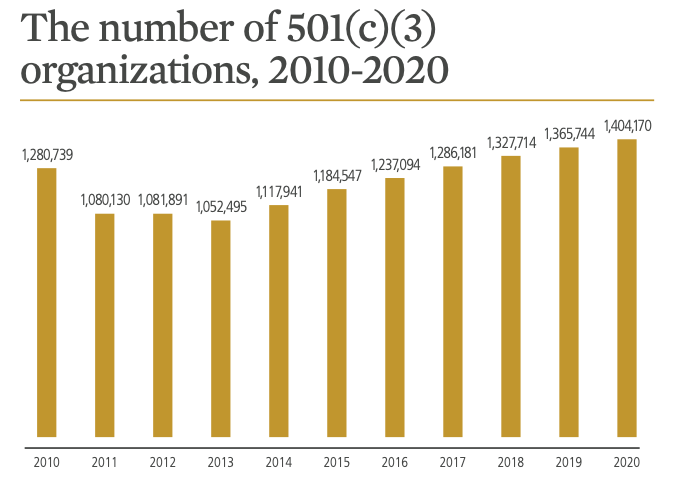
Here, we can see that in 2020, there were about 1.4 million tax-exempt nonprofits.
Different sources list different numbers:
1.8 million nonprofits in 2017 (Philanthropy.com)¹
More than 1.5 million in 2016 (National Center for Charitable Statistics)²
Around 1.7 million in 2020 (Candid.org)³
Regardless of which number you pick, the space is overcrowded. In 2016 alone, 80,000 new nonprofits were created.⁴
Is this really necessary?
You may have noticed the sharp decline in the number of charitable organizations between 2010 and 2011 in the graph above. This was due to the Pension Protection Act of 2006, which meant that all nonprofit organizations (excluding religious organizations) had to file tax returns beginning in 2007. In September 2011, over 200,000 charitable organizations lost their tax-exempt status for failure to file legally required documents for three consecutive years.⁵ Giving USA says that most of these organizations were likely small and defunct.
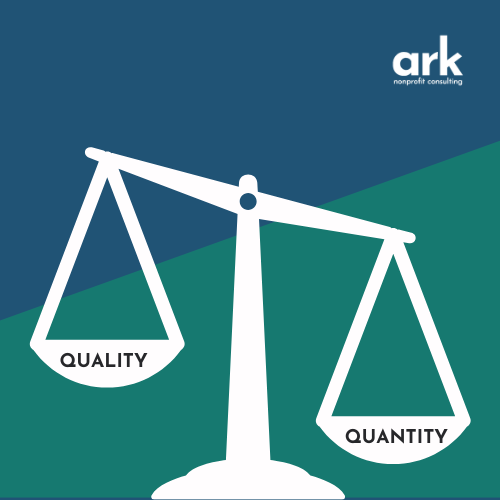
Despite the well-intended efforts of founders, there’s a “quantity over quality” problem in the nonprofit sector.
Why So Many Nonprofits Fail
Data from National Center on Charitable Statistics reveal that approximately 30% of nonprofits fail to exist after 10 years,⁶ and according to Forbes, over half of all nonprofits that are chartered are destined to fail or stall within a few years due to leadership issues and the lack of a strategic plan, among other things.⁷
That doesn’t paint a pretty picture. We know many nonprofits fail…but why do they fail?
Too much dreaming, not enough strategizing
Dreams allow us to thrive, to feel excitement in our lives. However, it’s better if you combine dreams with an actionable strategy. Dreams are sexy; strategy, not so much, but they help dreams become a reality.
Because it’s so easy to create a nonprofit on paper, many people struggle to build a solid foundation upon which they can make their dreams a reality. They get caught up in the grand idea of improving people’s lives and don’t calculate how much support they actually need to make their nonprofit a success.
2. Straying away from the original mission
A solid business plan and strategy will help in all areas of a nonprofit, and one of those things is staying true to the mission. Whether it’s due to trying to help too many people, new leaders having different ideas on direction, chasing funding at the expense of everything else, or some other reason, “mission creep” can slowly but surely be the end of a nonprofit as it once was, diminishing its effectiveness and impact.
3. Focus too much on spending rather than impact
While ensuring smart spending is critical to a nonprofit’s success, you also can’t lose sight of measuring the impact you’re making. A low overhead ratio (spending on overhead versus spending on programs) doesn’t necessarily mean you’re making a greater impact. And if you don’t appropriately invest in infrastructure, then you’ll spend even more money to fix the resulting issues.⁸ For example, if you throw money at rolling out a program that doesn’t have a solid foundation (e.g., properly trained staff, well thought-out outreach strategy, modern technology), it will underperform or fail and you end up wasting funding and time that could’ve been better spent elsewhere.
It’s difficult for many nonprofits to measure impact (i.e. outcomes) because it requires going through a complex process, especially if the mission is broad and difficult to quantify. It isn’t impossible though. Candid outlines three steps to measure impact:
Build a logic model
Impact: What measurable change are you striving to achieve in the long-term?
Outcomes: What measurable change are you striving to achieve in the short-term? What would indicate that you are progressing toward your goal?
Outputs: What tangibles can you measure immediately?
Activities: What high-level steps are required to run the program?
Inputs: What resources (staff, money, technology, etc.) does the program require to be successful?
Determine the need for measurement
Are you measuring for management or strategy?
Collect the data
Qualitative: Narratives on attitudes and feelings
Quantitative: Raw numbers
4. Fear of Innovation
The status quo can kill a nonprofit. And if not, it will just remain stagnant and take up space. If you’re afraid of investing in new technology and new ways of working, you won’t create the impact that people need. Think your shitty website stuck in the 2000s is good enough? Don’t want to invest in a better donation payment system? Afraid to restructure your organization even though you need to? Not hiring staff with diverse backgrounds and experiences?
Nonprofits don’t have much room for failure, which makes it difficult to get creative and do things differently. Taking risks may be scary, but what’s even scarier is doing the same thing over and over again hoping for a different result.
5. Founder’s Syndrome
The passion, funding, and time of one person can drive a nonprofit’s success in the early stages. However, a founder can’t let everything rest on their shoulders in the long run–it’s simply not sustainable. When a founder feels the need to make and oversee every decision, they’re going to burn out. Not only that, but it can be difficult to cultivate new ideas in an organization and bring on new staff and volunteers. Who would want to be a part of a culture that revolves around the founder as opposed to the mission?
A founder should be passing responsibilities onto multiple people as the organization grows. It’s not a one-and-done event, but something that’s in constant flux as needs change. One person doesn’t have all the necessary skills to keep a nonprofit thriving for many years to come–you need a strong team and network of partners working together.
If you’re a founder, take the time to reflect on your role at your nonprofit. Is it suffering from founder’s syndrome, or do you foresee it potentially developing in the future? Ask your staff for feedback or work with a nonprofit consultant to help you gain clarity on your situation.
What Does it Take to Build a Nonprofit that Makes an Impact?
It’s extremely easy to officially create a nonprofit on paper. All you need to do is come up with a name, get an EIN, register it with your state and file a 1023-EZ. It will cost you a few hundred dollars and a few hours in total.
However, that’s only a tiny fraction of what’s required to build a nonprofit. What should happen before and after that? It’s no walk in the park.
Here are just a few things you should consider:
Have you done the research to determine the need for another nonprofit for this particular issue you care about? And I don’t just mean a few Google searches.
Is creating a nonprofit feasible for you? You’ll need a minimum of $2,500 to $5,000⁹ just to start your nonprofit, but after that, you’ll need to spend money on marketing, hiring, grant writing, etc.
Who will be your first hires?
What are your short and long-term goals?
How will you select your board of directors?
How will you reach your beneficiaries and donors?
What kind of fundraising activities will you organize and what resources are required for them?
Do you understand how to maintain your tax-exempt status?
And we’re just scratching the surface here.
I‘ve already said this, but I can’t stress it enough–build a solid strategy and foundation before getting into the weeds. It will serve as your compass in good and bad times. Even if you’ve already started your nonprofit and you realize, “Oh shit, I actually don’t have a strategy”, it’s not too late. Now is the perfect time to build one, whether you do it internally or enlist the help of a consultant, especially if you’re going into a new fiscal year.
4 Alternatives to Starting a Nonprofit
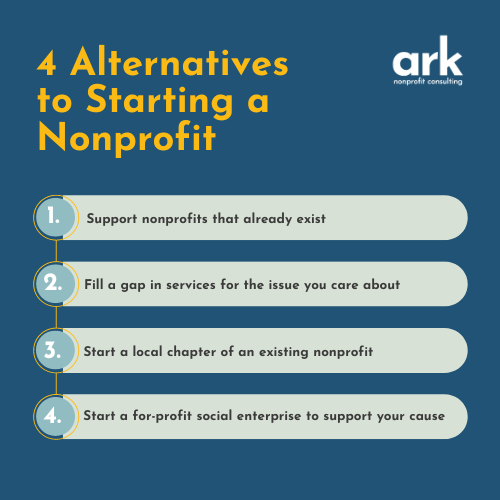
Consider the following options before you succumb to that urge to start your own nonprofit:
Support nonprofits that already exist
Nonprofits are already understaffed and underfunded as it is–so why not lend your support to them? They need more people willing and able to fight for the cause. Want to fight against domestic abuse against women? Support a local charity that helps battered women and their children find safe spaces and resources to get out. You can do that by donating money, volunteering, spreading awareness to your peers and loved ones, promoting them on social media, starting a fundraising campaign, applying for a job, joining their Board of Directors (if you’re qualified) etc.
You could even partner with an existing nonprofit that aligns most with your mission and meet with them to discuss how you could start an initiative or program within their organization.
2. Fill a gap in services for the issue you care about
Perhaps you’ve done some research and discovered that there’s a gap in the available services for the issue you care about. Why not fill that gap instead of starting a brand-new nonprofit? Plus, you’ll reap the benefits of working with an established organization. For example, you believe a particular neighborhood in your city could benefit from a meals-on-wheels program and have ideas about how to build it.
Reach out to an organization that you think would be able to support your initiative and propose your idea and/or plan. You’ll have a better chance of getting them on board if you show that you’ve done your research and how you could roll out this program.
3. Start a local chapter of an existing nonprofit
There’s a chance that there’s a multi-chapter nonprofit that supports the cause you’re interested in. Once you’ve found a national or international nonprofit that you’d like to join that doesn’t have a chapter in your area, do research to determine if there’s a need for a new chapter there. The next step would be to contact the appropriate person to see if there’s an opportunity to expand their impact with your help. Being a part of an established organization can bring major advantages like an existing marketing strategy and materials, policies and procedures as well as name recognition.
4. Start a for-profit social enterprise to support your cause
Greedy soulless corporations that destroy the planet aren’t the only for-profit businesses out there. Businesses aren’t inherently bad–there are plenty of social enterprises that make an incredible impact on the world.
Before starting a nonprofit, you should consider that a nonprofit with 501(c)(3) status may be subject to limitations that wouldn’t be ideal for advancing your mission. There’s more flexibility that comes with running a social enterprise–you may actually raise more funds and awareness for your cause as a result.
While a for-profit social enterprise might not have the same goodwill associated with it as a nonprofit, there are ways that can help differentiate it from more commercial for-profits, like a benefit corporation status or getting a B Corp Certification.
Still Think Starting a Nonprofit is a Good Idea?
If you’ve gotten this far in the blog and you’ve determined that starting a nonprofit would indeed make a difference, that’s great! You might be onto something. For example, if you live in an area where there are no organizations or businesses that provide support for an issue that desperately needs it.
The next step would be to research how you would fund it (beyond any investments you’d make yourself). If you’d rely too heavily on outside funding, you might want to reconsider. However, if it can sustain itself without having to compete with other nonprofits for the limited resources available, you’re on a good path. But as mentioned above, you might want to explore whether a for-profit venture would be more fruitful in this case.
If you’ve determined that starting a nonprofit will make the most impact, we can help you get started and lay the groundwork for future success. We understand how damn hard it is, so we’ll be there with you every step of the way and develop an actionable plan to bring your ideas to life.
Sources:
https://www.philanthropy.com/article/irs-granted-tax-exempt-status-to-nearly-80-000-groups-in-2016/
https://nccs.urban.org/publication/nonprofit-sector-brief-2019
https://search.issuelab.org/resource/key-facts-on-u-s-nonprofits-and-foundations.html
https://ssir.org/articles/entry/the_nonprofit_starvation_cycle
https://www.forbes.com/advisor/business/how-to-start-a-nonprofit/